The latest anti-corruption actions in the People’s Republic of China (“PRC”) in late December 2023 and early January 2024 have highlighted the degree to which a “stockade mentality” has taken hold in official circles, as in the 1950s.
Anti-corruption initiatives
The Politburo (中共政治局) of the PRC in December 2023 noted that anti-corruption efforts in the year ahead would focus on catching “flies and ants” (蝇贪蚁腐) – making clear that there would be no let-up in the anti-corruption initiatives under way now for over a decade.
Then, in late December 2023, the authorities suddenly removed senior members of the People’s Liberation Army (“PLA”) Rocket Force, as well as naval and air force chiefs. Claims that corrupt officials had watered down fuel and otherwise acted to weaken China’s military emerged.

China’s rocket forces
The exact reasons for action against PLA officials are not entirely clear. Some commentators suggested the arrests related to the downfall of former Foreign Minister Qin Gang (秦刚), while others have suggested that the move sought to replace senior officers who voiced doubts about the PLA’s engaging in conflict – possibly over Taiwan or in the South China Sea.
Either way, the action against the military highlighted how dominant Xi Jinping has become in the Chinese Communist Party (“CCP”) apparatus – in that the General Secretary need not fear action against the soldiers – and how determined the government is to shore up its military strength in the context of the deteriorating international climate.
These latest campaigns are also noteworthy as signposts of the degree to which a “stockade mentality” has taken hold in governing circles – a trend that is strengthening already powerful statist impulses in economic policymaking.
Back to the future?
Some parallels can be drawn with the early 1950s – indeed, CCP officials may be doing so.
At that time, the CCP offered government that was stabler and less corrupt than that of the defeated Kuomintang (“KMT”). The CCP cadres were literate, motivated, and able to assist villagers.
An emphasis on simple living and honesty was important, in the context of a similarly contested international climate.
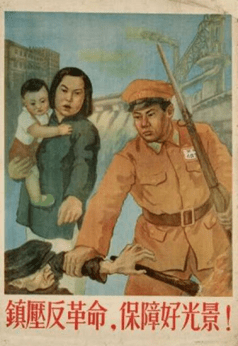
Anti-Counter Revolutionary Campaign Poster
However, what is also true is that the political campaigns of thet 1950s led in time towards a much-tighter political climate, and closer government control of business, in the PRC.
The Campaign to Suppress Counter-Revolutionaries (鎮壓反革命運動) sought to tackle internal threats, for instance, and the Three Anti and Five Anti- campaigns (三反五反), sought to root out corruption and to weaken private business for subsequent takeover.
Overstated?
The current anti-corruption campaigns are nothing like as widespread as those of the 1950s. Even so, it is clear that a similar turn inwards is now under way in the PRC, with serious implications for regional stability and the business climate. The trend is thus worth watching.

 Living with the Dragon
Leave a reply to Paul Lillie Cancel reply