Many people’s favourite treat in Chinese restaurants are xiaolongbao (小笼包), or little basket buns.
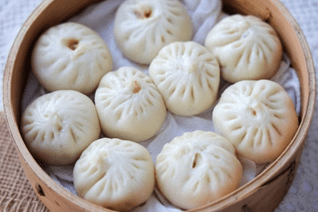
Truly, xiaolongbao are one of the best bite-sized treats in Chinese cuisine.
Eating them is an art. The trick is to place the dumpling on a spoon with chopsticks, nibble a small hole in the wrapper, and then to suck out the stock; that way, you avoid a burnt tongue.
Origins
Their origins are a little obscure. Soup dumplings reportedly emerged in Kaifeng during the northern Song dynasty, from about 960 to 1127. Kaifeng (then called Bianjing) was the most sophisticated city in China, and street traders and restaurants sold the soup dumplings to a refined crowd of scholars, officials, and merchants.
The shape of the dumplings, with the wrapper gathered at the top, reportedly resembled a chrysanthemum, while the wrapping was as said to be as white as the famous ceramics from Jingdezhen (景德镇) in Jiangxi province.
However, the Song dynasty faced disaster in 1126, when the Jurchen, a group of nomadic, horseback raiders, besieged Kaifeng. The Jurchen pulled back from the walls, but tried again and eventually took the city in 1127, also capturing the luckless Emperor Song Huizong.
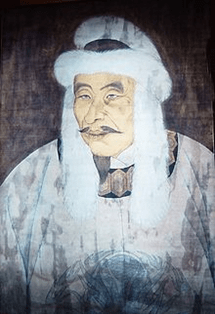
The founder of the Jin Jurchen dynasty, Aguda (who died in 1123; his son conquered Kaifeng)
Song Huizong was a fine artist, who ran an impressive painting workshop in his palace, but was inattentive and weak as a ruler.
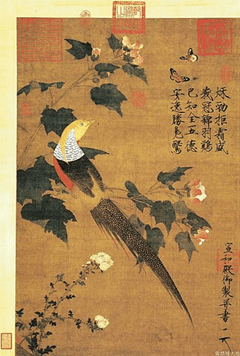
A painting of a golden pheasant by the Huizong Emperor
For his failings, Huizong was led into captivity in what is now Heilongjiang, trundled north on a cart, while his enslaved family and palace attendants trudged alongside; many died of hunger or exhaustion in the snows by the wayside. Patricia Buckley Ebrey has written a good biography of Huizong, describing this tragedy, known as the Jingkang Incident (靖康事變).
The Jurchen then took control of the northern half of China, having established their own dynasty, calling themselves the Great Jin (大金). The Song dynasty managed to regain their footing in time, in part thanks to the efforts of the heroic general Yue Fei (岳飛), but only after a confusing period during which two emperors ruled simultaneously, and only in the south.
The dynasty ultimately decamped to a smaller but perhaps more beautiful capital at Hangzhou (then called Linan) in Zhejiang province, but was thereafter always on the back foot; they essentially survived by bribing the Jin to leave them alone. In time, the Jin fell to bigger predators from the north, the Mongols, in 1234, as did the southern Song in turn in 1279.
Perhaps that is how the soup dumplings came to the Yangtze river basin. Some claim that the sophisticated officials who fled to Hangzhou took with them not only their loved ones and some household treasures on carts, but also a nostalgic pining for soup dumplings. Certainly, those in Hangzhou assert as much.
Other stories suggest that xiaolongbao became popular in Wuxi in Jiangsu, when the Qing Qianlong emperor (1711 to 1799) fell for the local version, which included crabmeat in the filling.
Others say they took off during the reign of the Qing Daoguang emperor (1820 to 1850), at the Wanhua Teahouse in Changzhou. Still others claim that Nanxiang in Shanghai was the venue where aspic was first added to the dumplings.
Success has many fathers.
Either way, xiaolongbao are now ubiquitous across Greater China, found in restaurants in Beijing, Shanghai, Hong Kong and Singapore alike. Always, they are good to eat.
How to make them
The stock
The first step is to make the stock, which is made from pig bones and skin, with a bit of meat and gristle still on them, chopped spring onions (scallions), two or three large slices of ginger, and a tablespoon of Shaoxing wine.
First boil the bones, and then throw out the water and rinse them. Then put them back in with about 950ml of water, and add the spring onions, ginger and wine. Simmer for about two hours.
Let the stock cool, and put it in the fridge. With any luck, it should turn to jelly overnight – if not add gelatin in the above process.
The dough
Use a cup of flour, and add about six tablespoons of water, and knead gently for about 20 minutes. Cover and let it rest for perhaps 30 minutes.
The filling
Mix together the below ingredients in a blender:
- 450g ground pork (70% lean, 30% fat).
- 2 tablespoons of shaoxing wine.
- 3/4 teaspoon salt.
- 1/2 teaspoonsesame.
- 3/4 teaspoon sugar.
- 3 teaspoons light soy sauce.
- 3 tablespoons water.
- Ground white pepper.
- 1 tablespoon minced ginger.
Then fold in the jellied stock, cut into smaller pieces.
Making the dumplings
Cut the dough into pieces of about 2 cm or so, and roll each out into a roughly 8-10 cm circle. Add a tablespoon of filling to each circle, and fold into the centre. The trick is to put together 12 or more folds or pleats; it is hard without practice !
Cooking
Place the dumplings on rice paper or a cloth in a bamboo steamer, and steam for about 8 to 10 minutes. They are best served with some black vinegar with sliced ginger – and right away.

 Living with the Dragon
Leave a reply to Zettl Fine Arts Cancel reply