The deployment of North Korean troops to Russia has drawn attention to the relationship between Beijing and Pyongyang – long known to be as close as “lips and teeth”
Old associations
These ties are old. The Ming dynasty intervened in support of Korea in 1592, for instance, in order to fight off a Japanese invasion during the Imjin War – famed for its “turtle boats” led by Admiral Yi Sunsin.
Perhaps the best personal recollection of that war comes from Kang Hang’s The Record of a Shepherd, a memoir of the Imjin War. Kang Hang was a Korean official, who described his wartime misfortunes, such as captivity in Japan.
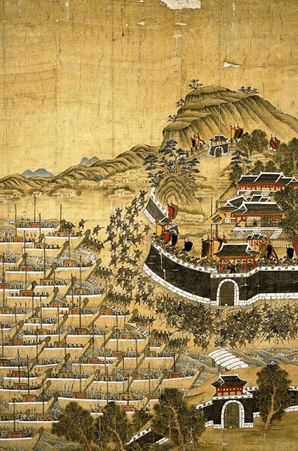
Japanese soldiers landing at Busan
Loss
Kang Hang writes movingly about the destruction caused by the Japanese invasion. His own grief was immense. He loses family, including two young children, who drown, his father, and his extended family is scattered, for good.
His writings also describe how he seeks to flee the marauding Japanese troops, but falls into enemy hands. Many episodes he recounts are tragic: a woman held by the Japanese asks another captive of acquaintances; one prisoner sings mournfully when bound; and brothers sadly enact traditional ceremonies in an alien land.
Captivity does provide an opportunity to learn about Japan, though. Kang Hang initially disdains the Japanese, but his perspective changes. He meets “good Japanese”, and notes that a “fondness for killing” arises from particular rules. Later chapters analyse Japan’s history, geography and institutions – Kang Hang saw himself as collecting intelligence about Japan for Korea.
Confucian culture
Kang Hang’s memoirs also make clear how tight were the cultural ties between China and Korea at that time. Kang Hang was expert on Chinese philosopher Zhu Xi (朱熹), and his adherence to Confucian traditions is strong; he mourns his father’s loss, and that of the family tablets.
What is also clear is how Kang Hang was a product of a relatively peaceful society. He served as a commander, briefly, but also engages in literary acts of resistance, by writing a protest poster to Japan’s leader Toyotomi Hideyoshi (豊臣 秀吉). His civilian manner contrasts with that of the samurai Japanese.
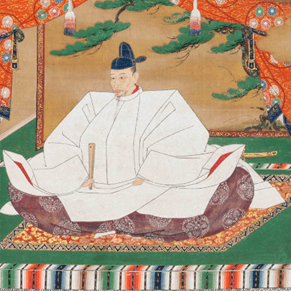
Hideyoshi
Korean nationalism
Of further note is that Kang Hang’s writings played a role in forging Korean national identity, just as did the Imjin War.
Kang Hang writes of discussions with Buddhist monks, and his conversations with Fujiwara Seika (藤原 惺窩), a Japanese monk, were historically significant. They seeded neo-Confucian precepts in Tokugawa Japan.
His writings provided a claim to cultural primacy for later Korean generations, to which the Japanese were sensitive. Indeed, at times, the writings were banned in colonial Korea, after 1910.
Mixed outlook
The detail in his writing is a great strength. Kang Hang writes of Japanese soldiers, of tools used by sailors, and of Buddhism in Japan – vignettes of immense value to historians.
Indeed, Kang Hang provides a superb first-person view of the Imjin War, offering deep insight into war-time experiences, into the plight of Korea at that time, and into cultural exchanges between Korea and Japan, which were later of great significance.
His writing is also a reminder of just how old and complex are the links between China and Korea – at a time of growing tension in East Asia.
 Living with the Dragon
Leave a comment