A current exhibition at the Hong Kong Palace Museum is showing some pictures from Ming Dynasty artists, such as Zhang Hong (张宏), an artist who lived from 1577 to sometime after 1652, at the turbulent tail end of the Ming Dynasty.
Zhang Hong
Zhang Hong was from Suzhou in Jiangsu province, but worked for a time as a magistrate in Jingzhou. He loved to travel and look at natural wonders, and is perhaps most famous for his landscape paintings (山水) in the Wu or Wumen School (吴门画派) style.
Landscape art reached something of an apotheosis during the Song dynasty, and became a sort of “counterculture” after the Mongol conquest, during the Yuan Dynasty. Disenfranchised scholars retreated to their homes and painted, in an act of unspoken rebellion.
The style revived during the Ming Dynasty, but in a conservative, backward-looking fashion; artists aspired to recreate the Song-era glories, even if they created something new by doing so.
A key character in this revival was Shen Zhou (沈周) (1427 to 1509), an early Ming progenitor of the Wu school – of which Zhang Hong is a later member.
The sketches
The scroll on display in Hong Kong contains sketches of acrobats entertaining people in the streets.
The drawings are especially striking for their simplicity of line; the museum is otherwise full of Qing Dynasty art, which is, by contrast, busy, spiky, and multi-coloured.
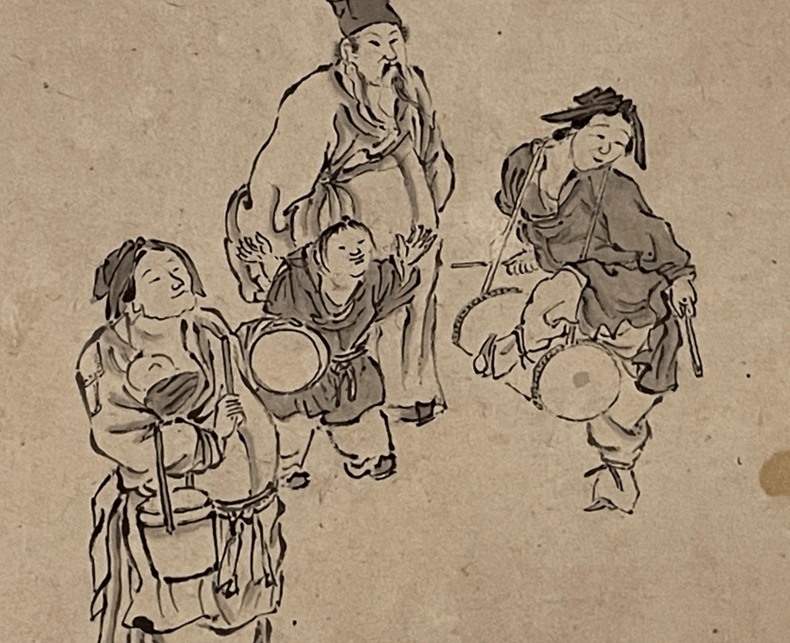
Acrobatics were largely seen as street-side entertainment, lacking the refinement of the arts displayed at the imperial courts.
Such displays had immense popularity, though, going all the way back to the Three Kingdoms period, and further, with acrobats competing for cash in the streets with soothsayers and storeytellers.
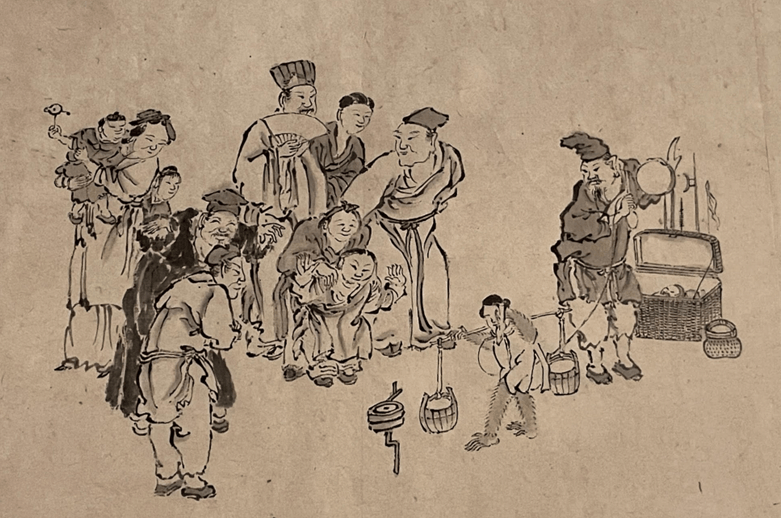
Zhang Hong’s drawings came during the chaos of the collapse of the Ming Dynasty, a time of peasant uprisings, barbarian invasions, and the treachery of Wu Sangui (吳三桂), who handed China to the Manchus.
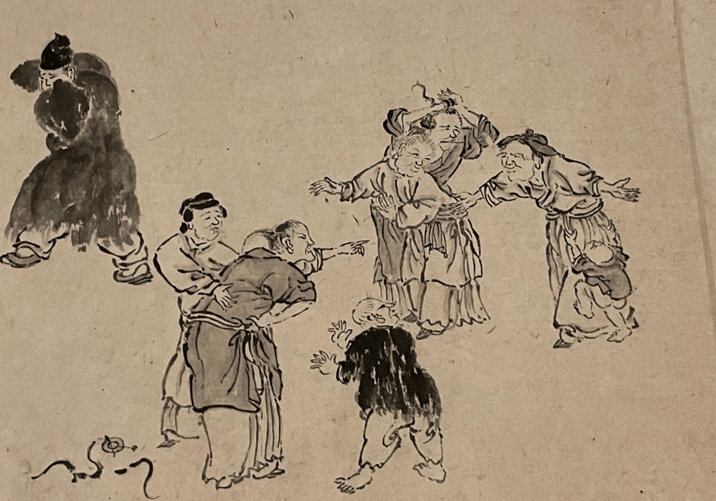
None of that is visible here, though, in the same way that Jane Austen’s novels make barely a mention of the Napoleonic Wars. Rather, the images capture the fun and chaos of streetside gatherings.
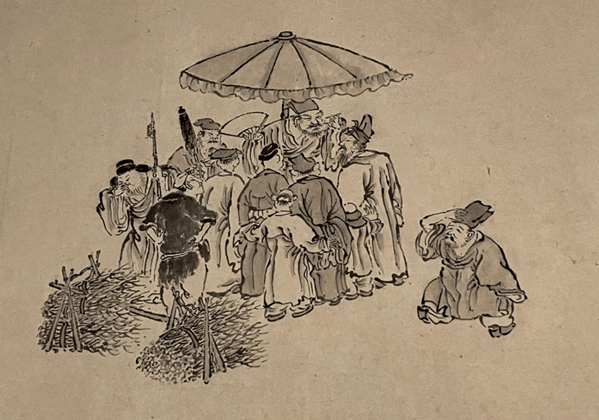
You can almost imagine you are in the crowd.
 Living with the Dragon
Leave a comment