Houthi attacks on shipping in the Red Sea have provided not only an interesting insight into how low-level maritime conflict can affect insurance markets, but also highlight broader geopolitical threats to China’s mercantile marine.
Giddying price rises
The attacks in the Red Sea have lifted insurance costs for US, Israeli and British shipping (admittedly hard to define in this globalised industry) in recent weeks – by as much as 50% for those passing by.
Rates have now stabilised, but their increase has highlighted the risk that insurers could refuse to provide cover at all – as is their right.
By contrast, rates for Chinese and other vessels remain manageable, as the Houthis are not targeting those ships. Indeed, prices for insurance for transit are as low as 0.35% of hull and machinery value for Chinese ships, compared to 0.5% and 0.75% for other vessels.
A boon
These reduced costs amount to a financial boon for Chinese shippers, adding to a time advantage of being able to sale directly through the Red Sea. Many western firms are now rounding the Cape of Good Hope, a much longer route.
The upshot is that Chinese shipping businesses have a price advantage over western firms, and some smaller Chinese companies have even won regional market share, thanks to their relative immunity from attack.
The sinews of power
The Houthi conflict has thus cast light on the role of insurance within the broader geopolitical contest.
After all, a large, autonomous mercantile marine is a crucial tool for states seeking to exert influence on a global level – and financial tools such as insurance and letters of credit are crucial for smooth sailing.
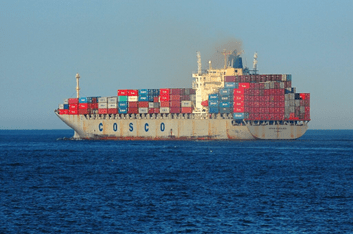
A Cosco container ship
Beijing clearly knows as much. China has built up its shipbuilding ability, and merchant marine, hugely since the 1980s, and now controls one of the largest fleets in the world.
Perhaps 5,500 vessels operate through state-owned enterprises such as China Ocean Shipping Company, Limited (中国远洋运输有限公司) (“COSCO”), which itself has 1,417 vessels with a total capacity of 116 DWT.
What is striking, though, is that China lags in terms of the “software”, given the challenges of settlement of offshore payments, and in terms of insurance.
Perhaps 80% of COSCO’s ships are still insured through the Lloyds insurance market, often by the mostly European 12 biggest P&I Clubs known sometimes as the International Group of P&I Clubs. Moreover, those clubs reinsure in the European markets, benefitting from the spread of risk that reduces costs.
Geoeconomics at work
Of course, China is benefitting from these attacks for now – but geopolitics can cut both ways. It is worth recalling that similar issues arose in the 1980s, when attacks on Kuwaiti and Saudi tankers by Tehran during the Iran-Iraq war resulted in steep rises in insurance rates.
That “tanker war” eventually prompted the Reagan administration to flag 11 Kuwaiti vessels as American in 1986, thereby re-instilling market confidence, and prompting an eventual decline in insurance rates. These events made clear how shipping is a crucial component of imperial systems.
Both Beijing and Washington are well-aware that western dominance of the insurance market remains a potential pressure point in the newly emerging contest for power. After all, the withdrawal of western insurance from many Russian ships after the outbreak of Ukraine conflict affected Russian oil exports.
Russia has managed to insure certain exports of oil through companies such as Ingostrakh (Ингосстра́х), a state insurer, and also worked with state-owned entities in purchasing states, such as India, to establish cover. A shadow system has thus emerged, although its value is well below that provided by western companies.
However, no Russian vessel has yet sought a payout, and other Russian vessels continue to rely to a large degree (perhaps 50% or so) on insurance provided by the western P&I Clubs. The strength of this new arrangement is thus not yet clear.
A vulnerability
Such a structure thus poses an acute strategic risk for Beijing. Chinese vessels could find themselves excluded from western insurance markets in the event of even a small conflict in the South China Sea.
Any halting of insurance would affect costs, adding to the price of goods, and could even halt shipping altogether, for a time. Beijing is already mindful of its exposure to stoppages, given a reliance on the import of commodities such as oil and copper, and on exports of goods for profit.
Former Chinese Communist Party Secretary General Hu Jintao in November 2003 even famously spoke of this Malacca Dilemma – albeit he was thinking in terms of an outright blockade on China. This led to the String of Pearls approach to establishing bases or friendly ports around the Indian Ocean.
Possible response
The obvious solution for Beijing would be to develop the local industry. China’s own P&I Club, the China Shipowners Mutual Assistance Association (中国航东互保协会), offers marine insurance.
For now, though, its scale is small, and it is reliant on western markets for reinsurance. Even so, China will probably be able to build up the sector, given progress in other areas, such as finance, the development of semi-conductors and electric vehicles, and aviation.
After all, much is at stake, and such “fortification” would be in line with other efforts to shift away from a reliance on the US dollar, so as to blunt US financial sanctions. The Chinese state is also in a position to compel companies to act.
A leading indicator?
All told, then, the Houthi attacks are providing a boon to China’s shippers and exporters – but China’s reliance on that system also highlights a strategic vulnerability, given the current geopolitical climate.
Observers hoping to establish whether China is likely to act in the Taiwan Straits or the South China Sea, then, would do well to watch developments in the insurance market closely.
A shift to Chinese provision of cover for Chinese vessels could well indicate a storm to come.
 Living with the Dragon
Leave a comment