This post continues an assessment of the outlook for Taiwan, after the victory of the Democratic Progressive Party (民進黨) (“DDP”) in presidential elections on 13 January 2024.
Maintenance of pressure
Since the poll, the People’s Republic of China (“PRC”) has maintained pressure on Taipei.
The Taiwan Affairs Office of the PRC government announced that the election would not depart from a path towards reunification – a point earlier made by Chinese Communist Party (“CCP”) General Secretary Xi Jinping in his new year address.
The small Pacific republic of Nauru also announced the shifting of diplomatic recognition from Taiwan to the PRC in mid-January 2024, thereby reducing the number of those states that recognised Taipei. This timing was noteworthy, in that the announcement came shortly after the poll, but is actually of limited consequence.
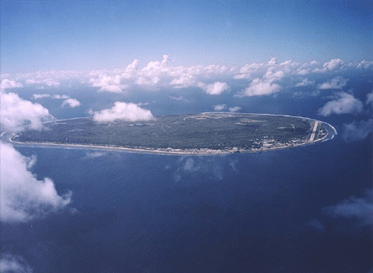
Nauru
Of greater significance, the People’s Liberation Army (“PLA”) conducted military forays near to Taiwan, with 24 planes and five navy vessels entering Taiwan’s air defence identification zone (“ADIZ”) on 17 January 2024. 33 aircraft then flew near Taiwan on 27 January 2024.
These deployments were not out of step with recent developments; ten ships crossed the “median line” (a de facto sea border) on 23 December 2023, for instance.
That said, it is worth noting that deployments of military assets in the Taiwan Straits have increased hugely in the last three years, meaning that the status quo itself is relatively fraught – and is far more complex that in the period from 1996 to 2020.
Worsening outlook
Unfortunately, expectations are that the situation could worsen in the coming months. For one thing, Beijing may raise pressure prior to William Lai Ching-te’s formal inauguration as president on 20 May 2024, in an effort to force him to make some moderate statements to which Beijing can seek to hold him.
A separate point is that Beijing may have demonstrated restraint hitherto so as not to worsen relations with the US. Certainly, bilateral ties have seen certain small improvements of late – with the reopening of military-to-military communications, for instance.
Beijing may also wish to wait for clarity from upcoming presidential elections in the US.
Planned US visits
A deterioration in ties with the US could thus readily result in heightened tensions over Taiwan.
Of note in that context are planned visits by US legislators. Those planning to travel in the coming weeks to Taiwan include Ami Bera, a Democrat from California, on the House of Representatives Indo-Pacific subcommittee, and two co-chairs of the Congressional Taiwan Caucus, Andy Barr and Mario Diaz-Balart, both Republican.
Mike Gallagher, the Republican chair of the House of Representatives Select Committee on the Chinese Communist Party, is also planning to travel to Taiwan, although the dates of that visit are not yet public. Gallagher has a reputation as a “China hawk”, and so could choose to heighten tensions.
These visits may draw comparisons with that of Nancy Pelosi in August 2022, which led to a five-day effective blockade of Taiwan by the PLA. As such, they could prompt Beijing to deploy military assets, and an associated rise in risk. This blog has previously looked at Beijing’s possible responses.
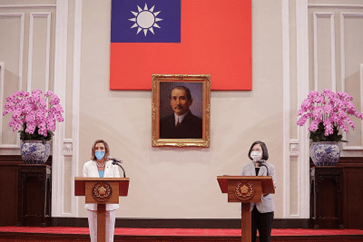
Nancy Pelosi in Taiwan in August 2022
An uneasy balance
An uneasy balance, then, is currently in place. For now, Beijing appears minded to maintain the status quo, with continued military deployments, further diplomatic pressure, and likely new trade restrictions.
However, this uneasy balance depends on a continued “détente” in Sino-American ties, a lack of provocative comments from the authorities in Taiwan, and restraint on the part of the US legislators visiting the island. The implementation of new US restrictions on technology such as semi-conductors or electric vehicles could also destabilise the balance.
The weakness of the Chinese economy is a further concern – as the Chinese government may choose to provoke external tensions as a means to divert attention from the ailing economy, and to justify a broader “stockade mentality”.
All and any of these events could affect the balance in the Taiwan Straits. As such, observers should plan for a deteriorating outlook.
 Living with the Dragon
Leave a comment