The preparation of a list of 50 property companies that the government wants to receive lending from banks has hinted at a rising willingness to bail out the ailing real estate sector in mainland China.
The Lucky 50
The People’s Bank of China (“PBOC”) was said to have prepared a list of at least 50 major property companies to which the banks can lend money, in an effort to encourage financial institutions to play the role of “white knight”, and to rescue some of the weaker companies. The banks are systemically powerful in China, and so the move is of some importance.
Discussion has since arisen about which companies are on the list, not least as the Chinese government had previously shown little willingness to bail out companies such as China Evergrande Group (中国恒大集团) and Country Garden Holdings Company, Limited (碧桂园控股有限公司).
There is arguably cause to act. The Chinese economy has slipped back towards deflation again, raising concerns that the real burden of debt will increase, and prompt further distress. Indeed, the Chinese government may soon have little choice but to bail out the embattled property sector in toto, regardless of concerns about moral hazard.
Moreover, the crisis has spread to affect the trust sector, as this blog has mentioned previously, which plays a lightly regulated, little understood but still crucial role in financial intermediation. Insurance could yet follow.
The preparation of the list is thus a step toward resolving the slow-motion financial crisis now under way.
What comes next
Recent Chinese history actually provides precedents for resolving debt crises. “Present at the creation” (after former US Secretary of State Dean Acheson) was a restructuring of debt process in the late 1990s, organised by then Premier Zhu Rongji (朱镕基).
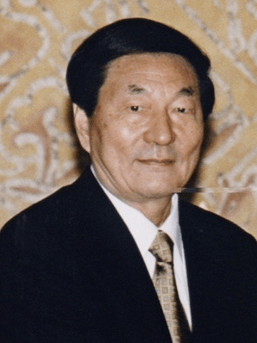
Zhu Rongji
Zhu, who was purged twice, once after the Hundred Flowers Campaign (百花园动) in 1957, and again during the Cultural Revolution, made his career thereafter in economic statecraft.
He rose through the Ministry of Petroleum and the State Economic Commission, before serving under then Chinese Communist Party (“CCP”) Party Secretary for Shanghai, Jiang Zemin (江泽民). He became Vice Premier in 1994, and Premier in 1999.
In particular, Zhu presided over a series of fiscal and financial reforms from about 1994, when the government restructured the fiscal balance between central and local governments. He also organized a debt restructuring process from about 1999 for the banks, which were ailing in the wake of the 1997 Asian financial crisis.
Zhu established a series of “bad banks” then, or Asset Management Companies (“AMCs”), called China Cinda, China Orient, China Huarong and China Great Wall, which took on bad loans. The original intention had been for these entities to settle the debts and then fade away, but these institutions have instead evolved into major financial players today.
Even so, Zhu’s approach has since informed almost all other efforts at debt restructuring – although most subsequent efforts have involved political as well as economic issues, and have entailed the reining in or shutting down of conglomerates linked to tycoons who had become too powerful for Beijing’s tastes.
Key examples have included: Tomorrow Holdings Company, Limited (明天控股有限公司), controlled by Xiao Jianhua (肖建华), who was seized by Chinese security officers from his hotel in Hong Kong on 28 January 2017 and rendered to mainland China; HNA Group (海航集團), which was said to have links to former Vice President Wang Qishan (王岐山); and Anbang Insurance Group (安邦保险集团), which was controlled by Wu Xiaohui (吴小晖), the ex-husband of Deng Xiaoping’s granddaughter.
All were overextended, financially and politically, and dealt with roughly on the same basis.
The model
The upshot is that a model exists for resolving debt issues in the PRC. As a rule, the government steps in, even if claiming it has not, represented sometimes at arms-length by major state owned enterprises (“SOEs”), or even a private business.
Investigations usually follow, resulting in arrests, and convictions, and often straying into other sectors, in line with patronage networks, or other linkages. This fallout lasts years, usually.
The SOEs then inject working capital, where needed, and work to separate the promising from the toxic assets, restructuring the businesses. In certain cases, local or central government SOEs may take on assets, even where the commercial logic for doing so is weak.
This process can appear to be a division of the spoils, and sometimes leaves a rump business in place, sometimes not. The rump business may remain formally “private” – although the dominance of the state is the clear takeaway in this process.
Implementing the plan
The drawing up of this list of 50 entities, then, suggests that this process is now moving forward. In time, Evergrande, Country Garden or other property companies, may go on the chopping block – and, as previously, foreign investors’ interests will not be a priority for those making decisions.
 Living with the Dragon
Leave a comment