Louis Cha Leung-yung (查良鏞) was without doubt one of the most popular writers in Chinese in the last century. However, his influence extended well into other spheres, such as journalism, as founder of a major newspaper, and politics, as a member of Hong Kong’s Basic Law Drafting Committee.
Rivers and Lakes
Louis Cha is best known for his many jianghu stories (江湖- meaning rivers and lakes – an allegory for errant warriors in a historical setting), which were told in sprawling book series that won a huge readership around the Chinese speaking world. The books are true epics, often structured around their main characters’ learning and honing of martial arts, before acting to influence the flow of history in some way.
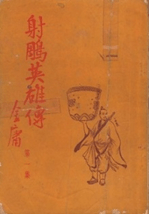
Perhaps his best-known book, the Legend of the Condor Heroes (射鵰英雄傳), for instance, tackles the period after the Jin takeover of northern China, in the 13th century, and has recently been translated and published in English.
Others deal with similarly complex periods of history, such as The Deer and the Cauldron (鹿鼎記), but depart from the traditional heroic formula. In that series, a slightly lazy and cunning character, Wei Xiaobao (韋小寶), makes his way through a series of escapades during the reigns of the Qing Shunzhi (1638 to 1661) and Kangxi (1661 to 1722) emperors. For instance, Wei Xiaobao is caught up in the Rebellion of the Three Feudatories (三藩之亂), an uprising of three warlords which lasted from 1673 to 1681.
Eventually, though, Wei is overcome by his contradictory loyalties to the Kangxi emperor and the tiandihui (天地會), the precursors of the triad societies, which emerged in the 17th century in order to Oppose the Qing and Restore the Ming (反淸復明). Unable to reconcile his feelings, Wei retreats into seclusion with his family.
Many of these books have been made into television series over the years, and are very much part of the cultural furniture in Hong Kong and Taiwan. Some of Hong Kong’s most famous film stars have played the key roles, too.
Life and times
Louis Cha’s own story is almost as rich as the characters in his books.
He was born in Hangzhou in Zhejiang province in 1927, to a rich family of scholars and landowners, but bucked against the Kuomintang government – and was expelled from school. He later studied law in Suzhou, graduating in 1948, at the height of the Chinese Civil war.
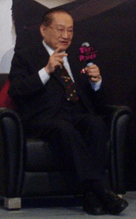
Louis Cha
He then started work at the respected newspaper Ta Kung Pao (大公报) in Shanghai in 1947, but moved to Hong Kong in 1948, leaving mainland China ahead of his family.
However, his family did not fare well after liberation in 1949. His father Zha Suqing (查樞卿) was arrested and executed by the Chinese Communist Party (“CCP”) during its campaign against counterrevolutionaries in the 1950s.
In Hong Kong, in the 1950s, Louis Cha started writing his first book, The Book and the Sword (書劍恩仇錄), which was set during the reign of the Qing Qianlong emperor. In 1955, he left Ta Kung Pao, and in 1959 founded a rival newspaper, Ming Pao (明報), which over time became one of Hong Kong’s most literary and respected newspapers.
The newspaper had a staff of only four initially, including Cha himself, but Ming Pao used the serialization of the Jin Yong novels to draw in a readership. The newspaper thereafter grew into a respected voice in Hong Kong, and more widely around the Chinese language world.
Political voice
Louis Cha also developed into a prominent political commentator.
Indeed, Ming Pao published a series of editorials in 1966 criticising the excesses of the Cultural Revolution. Cha’s standing was such that he was reportedly on a hit list put together by leftists during the bloody 1967 riots in Hong Kong, a time of protests, shootings and bombings that left 51 people dead.
Indeed, throughout his career, Louis Cha remained a champion of traditional Chinese values. Some commentators claim that, although he drew on Confucian, Daoist and Buddhist antecedents, the greatest influence was perhaps Mo Zi (墨子) (c 470 BC to c 391 BC), who advocated a philosophy supportive of universal love, social order, meritocracy, and honouring the worthy.
Hong Kong’s development
Louis Cha was also a staunch Chinese nationalist, which Deng Xiaoping, who met Louis Cha in 1981 to discuss Hong Kong, appeared to see. Accordingly, in 1985, Louis Cha joined the Hong Kong Basic Law drafting committee, which wrote the Special Administrative Region’s mini-constitution.
Louis Cha had had doubts about joining the committee. He decided to take the role, though, on the basis that the law would define Hong Kong’s future, and on the committee showed a knack for bringing together conflicting sides. However, he resigned after the 1989 Tiananmen massacre.
Ming Pao
Louis Cha also retired from Ming Pao in 1993, although he afterwards drafted a conservative proposal for the selection of the Chief Executive of Hong Kong through a “broadly representative” committee. Critics at the time felt that he had not acted in the best interests of democracy in that role.
His political legacy is perhaps more contested than his literary one. Ming Pao has since succumbed to CCP control. Ahead of the 1997 handover, the CCP had increased its control of Hong Kong’s media, including Ming Pao, although the paper continued to publish vibrant stories for some time thereafter.
That changed from about 2012, however, with a knife attack on the head of its publishing division, Kevin Lau Chun-to (劉進圖), on 26 February 2014. The division had previously sold lurid books abut the goings-on in mainland China, but the attack was a sign of things to come.
The resignation of prominent journalists thereafter weakened the paper, although it continues to publish.
All told, Louis Cha left behind a deeply impressive legacy, both literary and political, in Hong Kong and more widely.
 Living with the Dragon
Leave a comment