Most people are well-aware of the role of Confucius in Chinese philosophy. However, fewer are conscious that the philosopher, who lived from about 550 to 479 BC, was really interpreting an older set of precepts associated with a sort of “philosopher king”, the famous Duke of Zhou or Zhou Gong (周公).
The Duke of Zhou
Zhou Gong lived at the tail end of the Shang dynasty (商朝), a truly ancient period in Chinese history, from about 1600 to 1100 BC. The Shang dynasty was when China’s first states emerged, and when the character-based system of writing originated in geomancy and fortune telling.
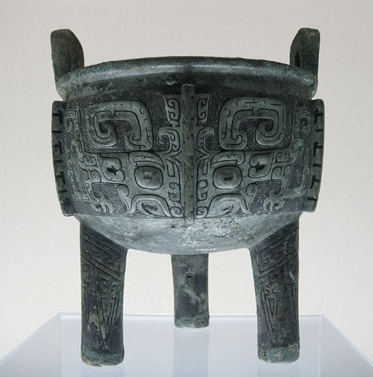
Its artistic heritage is closely associated with the dings, or tripod cauldrons, which are often found in many Asian museums. These bronze artifacts often boast intricate patterns, sometimes reminiscent of the shapes common to Mayan culture in Meso-America.
However, the Shang was losing its grip by about 1050 BC, when the last Shang King, Shang Di Xi (商帝辛), previously a robust warrior, surrendered to debauchery.
He famously built in his palace a “pool of wine and a meat forest” (酒池肉林) (a proverb now meaning absolute excess in Chinese), and gave himself over to dalliances with his beautiful consort Daji (妲己).
Daji is something of a “Messalina” (the promiscuous and murderous wife of the Roman emperor Claudius) in Chinese history. She was said to delight in the torture of others, even developing a technique using a heated bronze pillar to sear victims (炮烙).
She has even been said to have introduced foot binding as a means to disguise her small feet, which were a product of her being a fox spirit, as outlined in the famous novel The Investiture of the Gods (封神演義) and other myths.
Shang Dixi and Daji’s excesses ultimately led those around them astray, the state system started to fail, and chaos spread across the land. Consequently, the Shang fell, Daji was executed, and her head was hung on a white flag.
Daji may have been a nasty character, but this story still recalls many instances whereby a misogynistic historiography blames the collapse of a dynasty on a woman’s transgressions (the concubine Yang Guifei similarly received the blame for the An Lushan rebellion against the Tang dynasty in 755).
Either way, after the war, Zhou Gong helped his brother, King Wen of Zhou (周文王), in founding a new dynasty, the Zhou (周), in about 1045 BC. Zhou Gong then loyally served as the regent for his nephew, King Cheng of Zhou (周成王), in the 1040s BC, ruling well and wisely.
Given the distance in time, of course, much of this history is mythical, written almost as entertainment by, amongst others, the Han dynasty court historian Sima Qian (司马迁) in about 145 AD.
Even so, those myths have played a founding role in Chinese philosophy and political thinking.
The mandate of heaven
In terms of the evolution of Confucian thinking, the most significant precept attributed to Zhou Gong, then, is that of the mandate of heaven, or tianming (天命).
This precept is essentially that a ruler enjoys a mandate to govern “all under heaven” (天下 – tianxia), but that a ruler can lose that mandate.
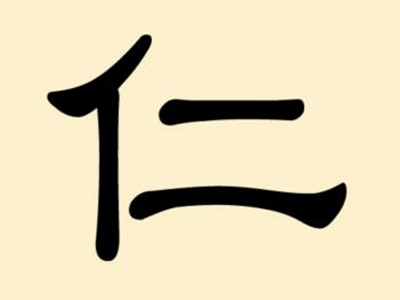
In order to deserve the mandate, rulers must display humanness (仁 – ren). Those that fail to do so will forfeit the mandate; and key signs of its withdrawal included disaster in battle, famines or natural disasters, and bandit uprisings that undermined law and order.
A rebellion thereby became justifiable, and a new dynasty took over. In a somehat poetic way, the sense of investiture by the heavens mirrored the way a sovereign might appoint a feudal lord in the period before the Qin Empire, which was usually done with a seal or chop (封).
Over time, this concept has become almost circular, with a sense that each dynasty would take control, establish order, and legitimize what was usually just a usurpation. Later emperors would then become corrupt and debauched, before disaster and uprising resulted in the dynasty’s deserved fall and replacement.
Some commentary points to this cyclical notion of history as fundamentally different from the linear form developed in ancient Greece, so explaining certain cultural differences between Chinese and European civilization.
Regardless, in the sixth century BC, Confucius took many of these ideas and built them into his much more complex, refined and sophisticated philosophy.
Up until today
The concept of the mandate of heaven still underpins aspects of political thinking in China.
For instance, the 1976 Tangshan earthquake was said in some quarters to presage the death of Mao Zedong, just six weeks later on 9 September 1976.
Similarly, debates still rage about whether the Chinese Communist Party (“CCP”), the latest dynasty to control mainland China, has or will lose the mandate of heaven, by failing to provide for its people, or perhaps by losing legitimacy as Taiwan drifts away.
For now, those debates are unresolved.
 Living with the Dragon
Leave a comment