I had not intended to write again so soon about Taiwan, but a hoped-for deal between the Kuomintang (國民黨) (“KMT”) and the Taiwan People’s Party (台灣民眾黨) has already collapsed.
The deal’s foundering means that William Lai Ching-te (賴清德) of the Democratic Progressive Party and his new running partner, Hsiao Bi-khim (蕭美琴), a former ambassador to the US, are once again favourites to win the presidential election on 13 January 2024.
The deal had provided some reasons for optimism about regional security. Beijing favours a KMT victory, and sees William Lai as a champion of Taiwanese sovereignty; a KMT success may have helped calm tensions.
This post will touch on some of the options open to China in the event of a DPP win.
What to expect
Beijing has previously intervened in Taiwanese presidential polls, in an effort to prevent a DPP victory. Such interventions are likely to intensify in the coming months, ahead of the poll.
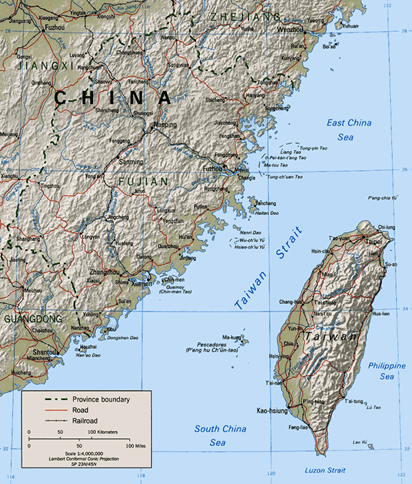
The Taiwan Straits
Beijing has form in this regard. Most notably, from July 1995 to March 1996, the People’s Liberation Army (“PLA”) launched missiles near Taiwan, to intimidate voters into opposing Lee Teng-hui (李登輝); and, in 2000, Beijing warned against voting for DPP candidate Chen Shui-bian (陳水扁).
These actions actually proved ill-considered, though, in each case bringing in more votes for the “wrong” candidate. Even so, comparable interventions could come in the coming months.
China may also feel compelled to act in response to William Lai’s inauguration in May 2024 – although the upcoming US elections, in November 2024, will weigh into calculations, by introducing uncertainty into American policy.
Escalatory options
In terms of actions, Beijing has a number of options at hand. At the lower end of the escalatory scale is the rough continuation of the status quo, perhaps with some more military exercises and measures aimed at intimidating Taiwan.
Next on the escalatory ladder are more disruptive actions, including greater deployments of military assets, and intrusions closer to Taiwan proper, cyber-attacks, diplomatic pressure, efforts to cut fiber optic cables, and other “grey zone” measures, perhaps to include the firing of missiles over Taiwan.
Another option is a blockade of Taiwan, partial or complete, with the deployment of PLA vessels and aircraft to cut off access. The PLA effectively carried out such a blockade after US House of Representatives Speaker Nancy Pelosi visited Taiwan in August 2022, albeit only for a few days.
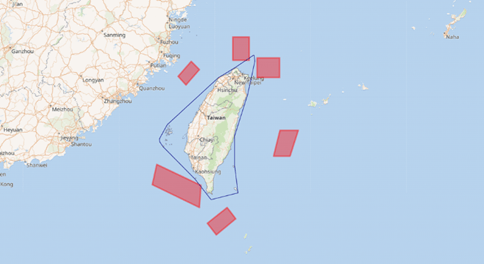
Areas of PLA deployment around Taiwan in August 2022
A major risk, though, would arise were US-flagged, or other, vessels to push through Chinese lines, perhaps triggering an exchange of fire – as was the threat during the October 1962 Cuban Missile Crisis.
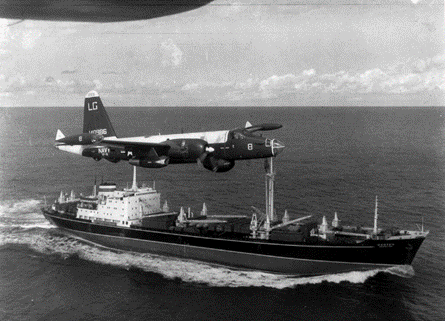
A US P-2H Neptune overflying a Soviet cargo vessel near Cuba in 1962
Even more aggressive options include localised military action, perhaps triggered by the accidental targeting of an aircraft or ship, or the seizure of some of Taiwan’s essentially indefensible offshore islands.
Finally, the PLA could attack Taiwan outright. For now, though, its doing so seems unlikely, as the PLA could struggle to overcome the logistics involved, a military build-up would be hard to hide, and US and Japanese intervention could easily result in a regional conflagration.
Of course, Beijing may yet miscalculate that a sudden swoop would lead to Taipei’s quick surrender – recalling Putin’s error in Ukraine.
The prospect of a blockade?
Looking at the above, a blockade is perhaps the most likely option, should Beijing wish to escalate; certainly historian Niall Ferguson thinks as much.
After all, Beijing may feel a need to respond to William Lai’s election, and may see commitments to Ukraine and the Middle East as reducing Washington’s ability to respond.
Beijing may also calculate that a blockade will not result in outright conflict, and could intimidate Taiwan into compliance, and hence be worth the risk.
Economic implications
Quite what a blockade might mean, though, would depend on its duration and scale.
Even a loose blockade could divert much commercial traffic away from Taiwan and the straits (especially if the Lloyds War Risk Committee designates the area a warzone, affecting shipping insurance). An immediate impact could be the closure of key shipping lanes and severe disruption to supply chains around Asia.
A tighter and longer blockade would have a proportionally bigger impact. Some analysis by the Global Peace Index suggests that a strict blockade could cost the world economy USD2.7 trillion in the first year, and perhaps could prompt a 2.8% decline in global economic activity.
China would suffer significantly. Its economy might shrink by 7%, but that of Taiwan could decline by 40%. Australia and Vietnam would also see declines of 3% to 6%. The industries most at risk would initially include electronics, automotive production, medical equipment, and pharmaceuticals.
A blockade would have especially big consequences for exports of semi-conductors. Taiwan produces 20% of all semi-conductors, 37% of logic semi-conductors, and 92% of advanced logic semi-conductors. The consequences of a stoppage in supply would thus be dramatic, given their importance in everything from washing machines to robots.
The secondary consequences are even harder to predict. No doubt, many states would implement measures aimed at protecting their economies, raising regulatory risk. Restrictions on trade would be a real concern; and any reduction of flows of goods from China could affect a host of other economies.
Parties could also implement measures aimed at “decoupling”, or the nationalisation of foreign businesses. The US, and its allies, may impose tougher sanctions on China; a restriction on the trading of the debt of Chinese companies, is possible, as could be China’s ejection from formal payment systems such as SWIFT, as with Russia.
Of course, this post is purely speculative, and no party really wants a war. Beijing may not escalate, and William Lai may act with caution.
Even so, it is worth considering how important the upcoming election in Taiwan is for regional security, and what is at stake for everyone should things go wrong.
 Living with the Dragon
Leave a comment