Reports that People’s Republic of China (“PRC”) property prices fell 0.38% in September 2023, the most in eight years, and that sales numbers have fallen markedly, highlighted again how the sector’s plight threatens the stability of the Chinese financial system.
To understand the implications of the property crisis, though, it is necessary to look at the Chinese financial system – and so this post will set out a short summary of some of the distortions at work in the Chinese economy.
The banks
The Chinese financial system differs markedly from that in western states.
In particular, the banks dominate the financial system, with the four biggest banks (Bank of China, Industrial and Commercial Bank of China, Agricultural Bank of China and China Construction Bank), providing perhaps three fifths of all lending.
However, these banks do not lend much to the general economy. Rather, funds mainly go to Chinese state-owned enterprises (“SOEs”), with strategic aims in mind – such as the development of those sectors considered of greatest importance by Chinese Communist Party (“CCP”) General Secretary Xi Jinping.
Moreover, the banks offer little in the way of a return on savings to depositors. As such, the borrowers essentially receive a subsidy at the expense of savers, in what some economists have called “financial repression”.
The property market
A number of consequences ensue, and account for the current mess. One is that savers often choose to place their funds elsewhere – and for many years have favoured the property market, drawn by its blistering rates of growth.
Accordingly, the major developers, such as Country Garden Holdings Company, Limited (碧桂园控股有限公司) and China Evergrande Group (中国恒大集团), benefitted from inflows of vast amounts of money, which then went towards rapid and widespread property development. Hence, the swathes of housing developments built across China over the last decade, many underused.
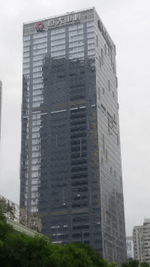
China Evergrande’s HQ
Further features of the financial system benefitted the property developers. In the US, most purchasers only put down a deposit on an unbuilt property, but in China purchasers could take loans on the entire value of the property, paid direct to developers. In effect, the inflow of cash meant that the property businesses could operate as de facto Ponzi schemes, reliant on a constant inflow of cash to pay for existing obligations.
In August 2020, though, the Chinese government implemented the “three red lines”, which suddenly tightened the leverage requirements for the property market. These measures provoked a screeching halt to the runaway growth, with seriously damaging consequences for the economy as a whole, given that property accounted for perhaps 25% to 30% of GDP.
The developers are now effectively insolvent. The Chinese government may save somefirms, although at the price of restructuring, with attention to the need to ensure that unbuilt apartments are completed. Doing so is a matter of social stability. Foreign bondholders, though, are liable to lose heavily.
The trust sector
A further consequence of the system of financial repression has been that consumers turned to the grey economy for much-needed lending.
A lightly (sometimes barely) regulated ecosystem subsequently emerged, built around trust companies. The trust groups emerged as a bewildering conglomerate of financial, property, insurance, wealth management and other interests, designed to circumvent restrictions.
Many trusts drew funding from the SOEs, thereby tapping bank funding indirectly, and then passed credit onto consumers, who might invest, in turn, in property or securities. This incestuous structure means that the extent of the liabilities likely to arise from the property downturn are extremely hard to quantify.
Some signs of the malaise are now emerging. In August 2023 Zhongzhi Enterprise Group (中植企业集团), one of China’s largest trust companies, faced liquidity problems. CITIC Trust and China Construction Bank’s trust divisions are now seeking to resolve the issues.
Weak government finances
The fallout is likely to go much further, though. The trust companies have long assisted local governments in managing their liabilities – a product of the fact that the central government takes in most revenues, but that local governments are responsible for most spending (about 85%), under a 1994 settlement.
Local governments have thus faced serious financial shortfalls for years, and used property speculation, often through special purpose vehicles, to fill the gap. Now, though, their credit position is deteriorating rapidly. The Chinese government is aware of this weakness; inspection groups went out to examine government finances in mid-2023, and the State Council announced plans to reform the system.
The next shoe to drop?
A separate concern relates to the insurance sector. Exposure is likely through several different channels. After all, many insurance companies, particularly life insurance, have invested in property, as natural fit for their long-term obligations. Now, those assets have fallen seriously in value.
A second concern is that many of the property and trust companies themselves include insurance businesses, which may now face serious shortfalls of capital, given the problems facing the general groups.
Indeed, reports on 8 November 2023 suggested that the Chinese government had asked Ping An Insurance to buy into Country Garden Holdings, in an effort to shore up the troubled property business.
What does this mean?
The Chinese financial system, then, is under serious strain. However, the Chinese authorities are unlikely to permit a full-blown financial crisis, and have the power to prevent any major panic.
Even so, these issues will trouble the financial system for years to come, and will affect the pace of growth in the months and years ahead – and hence the business opportunities in the PRC.
The Chinese authorities have a rough plan for dealing with comparable problems, which a future post will address.
 Living with the Dragon
Leave a comment