A decision by opposition politicians to cooperate in upcoming elections in Taiwan could make the race for president much harder to predict (provided it holds) – with implications for security in the Taiwan Straits and in the western Pacific.
An opposition United Front?
The Kuomintang’s (國民黨) (“KMT”) candidate Hou Yu-ih (侯友宜), current Mayor of New Taipei, and Ko Wen-je (柯文哲), current Mayor of Taipei and chairman of the Taiwan People’s Party (台灣民眾黨), tentatively agreed on 13 November 2023 to collaborate in opposing the governing Democratic Progressive Party (民進黨) (“DPP”).
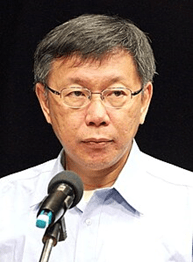
Ko Wen-je
This initial decision came after an accord on 30 October 2023 struck between KMT chairman Eric Chu (朱立倫) and Ko Wen-je, which aimed at preventing a “one party monopoly” under the DPP after polls on 13 January 2024.
Ko explained his reasoning, saying: “Running as a one-person party in a national election is tough. The KMT, after all, is a hundred-year old party, and, no matter how lousy it is ‘a starved camel is still bigger than a horse’.” (瘦死的骆驼比马大 – meaning roughly that a rich person’s ‘small’ is bigger than a poor person’s ‘big’).
Greater uncertainty
The alliance could threaten the prospects of William Lai Ching-te (賴清德), of the DPP, a former Vice President of Taiwan, and expert on spinal cord damage who has a reputation for supporting Taiwanese sovereignty – and hence is deeply disliked by Beijing.
Prior thinking had been that William Lai would win the election, thanks in part to support from current President Tsai Ing-wen. Recent polls had shown William Lai with 35% of support. Hou Yu-ih of the KMT had 18%, Ko Wen-je had 17%, and Terry Gou, founder of electronics giant Foxconn, had 12%.
The splintering of the opposition vote had made a DPP victory extremely likely. Now, though, the race could become much more even, suggesting that government could yet return to the KMT – in line with the traditional eight-year flip between parties.

The KMT logo
Possible friction?
Of course, the decision to work together is still uncertain, with a formal announcement only on 18 November 2023, ahead of the 20 November 2023 deadline for registering a presidential candidate.
Moreover, the question as to how the coalition will work is still unclear. The candidates differ markedly in character, and may struggle to finalise an accord.
Hou is a former policeman who investigated the shooting of former President Chen Shui-bian in March 2004 (the 319 Incident) (三一九槍擊事件). He favours closer ties with the mainland, but is also a benshengren (本省人), or Taiwanese local, unusual in the KMT, but meaning that he could pull in DPP voters.
Ko Wen-je (柯文哲) was a medical doctor, prior to entering politics, and is pragmatic on relations with China, but has a reputation for abrasive comments about women, gender and race. That said, the post of Taipei mayor is a traditional springboard for the presidency, and his “straight up” style has appeal, especially amongst the young.
The Foxconn question
One remaining wrinkle relates to the other opposition candidate Terry Gou Taiming (郭台銘), a tycoon who founded Hon Hai Technology Group (鴻海科技集團) or Foxconn, a major electronics manufacturer that contracts for Apple. He is running as an independent, and is in favour of the status quo in cross-Straits relations.
However, Foxconn has a huge presence in mainland China, and in late October 2023 the authorities in mainland China launched tax inspections in Guangdong, Jiangsu, Hubei and Henan provinces. The tax authorities have said that the inspections were routine, but many observers have asked whether they want to encourage Terry Gou to back out of the race.
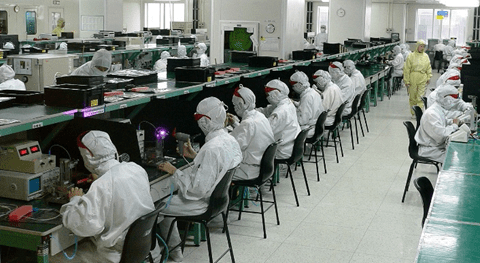
A Foxconn factor in Shenzhen
Should Terry Gou back the KMT, the DPP is much more likely to lose.
Bringing pressure to bear
In the background is the People’s Republic of China (“PRC”) government in Beijing, which would prefer a KMT victory.
As such, Beijing is exerting influence through its United Front Work Department and dealings the Taiwanese working and investing on the mainland – in previous polls, the Chinese even flew people back to Taiwan to vote.
The pressure on Foxconn is typical of Chinese actions at this point in the electoral cycle in Taiwan, then.
Other pressures are growing. China has launched an investigation into Taiwanese restrictions on certain Chinese products (usually for security purposes), hinting at the prospect of further coercive measures to follow. Bans on pineapples from the south of the island (a DPP stronghold) have occurred in the past.
Of equal interest are less savory influence operations, which include working with individuals alleged to have triad society links, such as Chang An-lo (張安樂), nicknamed the White Wolf (白狼), who has ties to the Bamboo Union (竹聯幫) triad society, perhaps the most powerful in Taiwan.
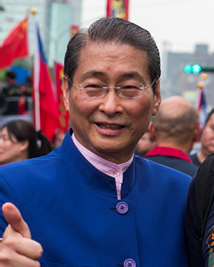
Chang An-lo
Chang runs the Chinese Unification Promotion Party (中華統一促進黨), and speaks often in favour of unification.
What comes next
The game is afoot, then, with the outcome of the upcoming elections much less certain, provided any agreement holds.
The outcome, though, will not only set Taiwan’s direction, but will also have major implications for cross-Straits relations, and for stability in the western Pacific as a whole.
A future post will look at Beijing’s possible responses.
 Living with the Dragon
Leave a comment